Before There Were Cheat Codes, There Was e4: The Board That Taught America to Read Shorthand
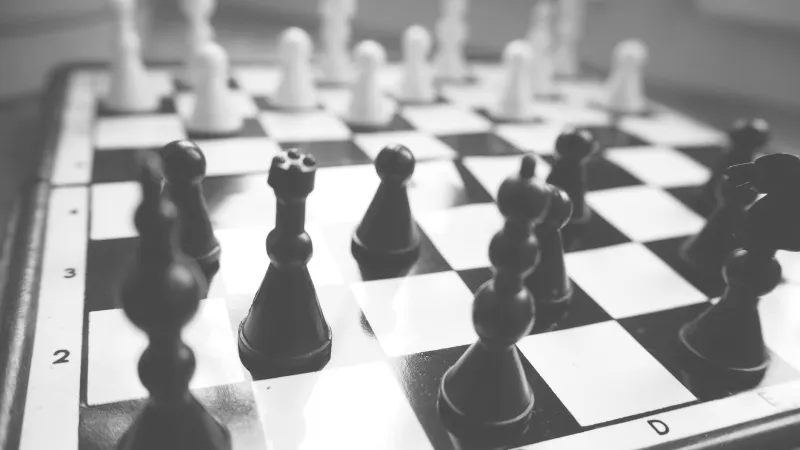
Type Nf3 into a room full of chess players and nobody flinches. Type it into a room full of everyone else and you might as well be reading from the Matrix. And yet that little cluster of characters — a letter, a lowercase letter, a number — is doing something remarkable. It's compressing an entire physical act (move this wooden piece to that square, threatening that other piece) into three keystrokes.
Sound familiar? It should. Gamers have been living in this language for decades.
The Oldest Compression Algorithm in the Room
Chess notation has been around in some form since the 1700s, but the algebraic system most players use today didn't become the international standard until the 1980s. That means for roughly two centuries, humans agreed to describe an infinitely complex game using a grid coordinate system and a handful of single letters. K for king. Q for queen. B for bishop. The knights got N because the bishops already called dibs on B, which is honestly the most relatable naming conflict in history.
"It's a symbolic language with strict grammar," says Dr. Elena Marsh, a computational linguist who studies how people learn notation systems. "You have a subject, a verb, sometimes a modifier. e4 means 'pawn to e4.' Nf6 means 'knight to f6.' Once you internalize the grammar, you can read a game the way you read a sentence — except the sentence is 2,000 years old and played by millions of people simultaneously."
If that sounds like reading a move list out of a fighting game manual, that's because it basically is.
From O-O to ↑→↘↓↙← + A
Here's the throughline nobody talks about: the arcade generation learned to read Nf6 before they learned to read ↓ ↘ → + Punch. Both are systems where a physical action gets flattened into symbols, and fluency in one primes you for the other.
Think about the mental leap a kid made in 1993, standing at a pizza parlor cabinet, memorizing that a quarter-circle forward plus a button meant a fireball. That's algebraic thinking. That's notation. The chessboard just got there first — and it did it with 64 squares instead of a joystick.
The 8x8 grid keeps showing up because it's the perfect teaching tool. It's small enough to see at a glance, big enough to generate near-infinite complexity, and it forces you to think in coordinates. When speedrunners talk about "the e4 strats" or Discord servers name channels after grid positions, they're all descending from the same intellectual lineage.
The Streamers Speak Fluent Shorthand
Marcus Tran, a chess streamer who pulls a few thousand concurrent viewers on Twitch, says his chat learned notation faster than any formal class could've taught them.
"I'll play Qh5+ and the chat is already typing 'sac the queen' before I finish the move," he laughs. "Nobody sat them down with a textbook. They just absorbed it because the format rewards decoding. There's a little dopamine hit when e4-c3-Nf6 stops looking like gibberish and starts looking like a story."
That dopamine hit is the whole thing. It's the same hit you get when you finally parse a fighting game frame data chart, or when a cryptic URL decodes into something meaningful, or when a Discord role color suddenly tells you who to trust in a trading channel. Subcultures run on shorthand, and shorthand runs on the promise that fluency equals belonging.
"Chess is the original gatekept-by-notation community," Tran says. "Except the gate is weirdly easy to open. You just have to want to."
Why the Grid Won't Let Go
Linguists have a term for what chess notation does: it's a reduced coding system — a way of representing a rich, physical, ambiguous reality with a small, precise symbol set. Human memory loves these systems. They're why we still use musical notation, why chemical formulas work, why we type "lol" instead of laughing out loud.
The 8x8 board just happens to be the oldest and most elegant one still in daily use. Every coordinate is unique. Every move is unambiguous. Every game can be archived, replayed, and argued about in a comment section 150 years later. Try doing that with a game of tag.
And the internet, built on text, is the natural habitat of a text-based game. It's no accident that chess streaming exploded during the pandemic — the notation was already URL-ready. A move like Rd8# travels through a Twitch chat, a tweet, a YouTube title without losing a single bit of meaning. That's not a bug of chess. That's the design.
Learn the Code, Join the Club
So the next time someone types O-O and watches half the room nod while the other half squints, remember what's actually happening. That's not insider gatekeeping. That's a 300-year-old compression algorithm doing exactly what it was built to do — sorting the people who wanted to learn the language from the people who didn't.
And if you're in the squinting half? Good news: the board only has 64 squares. The grammar fits on an index card.
The rest, as they say, is just practice — one move at a time.