Overheard in the Kitchen: The Half-Languages American Kids Grew Up Decoding
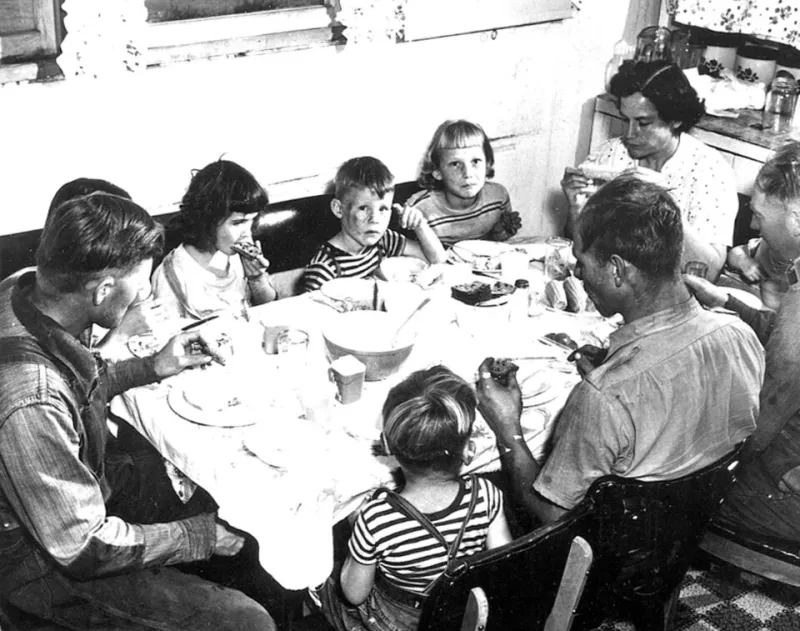
Photo: Galt Museum & Archives on The Commons, No restrictions, via Wikimedia Commons
Every kid raised in an immigrant household in America knows the sound. The phone rings, your mom picks up, and suddenly she's speaking a language you swear you've never heard her use — faster, looser, funnier, more alive. You catch maybe one word in ten. You laugh at the right moments anyway, because the tone tells you everything.
Nobody ever sat you down and taught you that language. You absorbed it sideways, like humidity through walls. Linguists have a term for the result — heritage language learners — but the people living it have a better one: they call it knowing just enough to be dangerous.
The Fluency Gap Nobody Apologizes For
Here's the strange math of the second generation: you can order food in your parents' language, scold a younger cousin with surgical precision, and sing every word of a lullaby — but you cannot discuss taxes, weather, or your feelings. Your vocabulary is a strange archipelago. Emotion words, food words, and insults cluster together on one island; everything else is open ocean.
Dr. Silvina Montrul, a linguist at the University of Illinois who has spent two decades studying heritage speakers, has found that these gaps aren't random. Heritage speakers acquire language the way anyone acquires their first language — through immersion — but the immersion zone was the kitchen, the car, the phone call with grandma in Guadalajara or Guangzhou or Karachi. So the vocabulary maps onto home. Not school. Not work. Not the news.
The result is a person who can say "you've gotten so thin, are you eating?" in three grammatical moods but has to pause and think about the word for Tuesday.
The Spice Tin Cipher
Walk into the pantry of almost any immigrant household and you'll find the evidence: jars with the store label scraped off or never applied, contents identified only by what your mother calls them. "The red one." "The bitter one, for the soup." A tin of something your dad calls by a name that turns out to be a regional word from a village 40 miles from where the dictionary says that word means something else.
For years, this was just background noise. Then you grow up, move out, and try to recreate a dish from memory, and you realize the recipe was never written down — it was transmitted orally, in a language you half-know, with measurements in units nobody sells ("a glass," "enough," "until it looks right").
Adult children across the US are now doing what archaeologists do with fragmented tablets: reconstructing. Reddit's r/heritagelanguage and a dozen Discord servers are full of thirty-somethings asking strangers to help decode a spice name their late grandmother used, or a phrase their father said before every road trip. The comments sections of cooking videos in Korean, Tagalog, and Polish read like crowdsourced decryption efforts.
Words That Mean More Than They Translate
Every heritage speaker has their own private dictionary of untranslatables. Not because the concepts are mystical — linguists roll their eyes at that — but because the context is untranslatable. A word your mother used to describe a certain kind of person carries twenty years of her phone calls inside it. The English translation is accurate and completely hollow.
Ask around and everyone has one: the phrase that only gets deployed in one situation, never explained, understood through pure pattern recognition. A word that meant "come inside, guests are here" and also "act normal." A sentence that functioned less as language and more as a household alarm system.
This is where the gaming-brained among us recognize the pattern. It's a cheat code — a sequence you entered without understanding why it worked, that unlocked something. You didn't learn the grammar; you learned the input. And like any code learned by imitation rather than instruction, it's full of errors you didn't know were errors until an aunt gently corrected you at a wedding when you were 27.
Why the Kids Are Learning Now
There's a quiet wave happening in community colleges and YouTube comment sections across the country: second-generation Americans in their 30s and 40s formally studying the language they grew up under. Enrollment in heritage language programs has climbed steadily, and the motivations are remarkably consistent — aging parents, kids of their own who ask questions, and a nagging feeling of having been handed a locked box without the key.
The reveal, when it comes, is usually emotional. People describe finally understanding what their parents were saying during the phone calls. Discovering that a phrase they thought was a nonsense family idiom is a common saying from their parents' region. Learning that their father's odd nickname for them is a word in a language he deliberately stopped speaking in front of the kids.
The gap, it turns out, wasn't carelessness. Sometimes it was a decision — the same one millions of immigrant parents made in the name of assimilation, back when the thinking was that one language per child was a kindness.
Decoding Is a Two-Player Game
What makes the reconstruction efforts so compelling is that they're inherently collaborative. You can't learn this language alone, because your half of it doesn't overlap with anyone else's. Your cousin knows the words you don't; your mom knows the words neither of you do. The family group chat becomes a joint puzzle session, each person contributing fragments.
And that might be the actual point. The language your parents kept half-alive in the kitchen wasn't really being spoken to you — it was being spoken around you, a private channel for a life before yours. Picking it up as an adult is the closest thing to being handed the transcript. You finally get to hear the full conversation.
Just enough to be dangerous. Turns out that's where every good decoder starts.