Cartridge as Cipher: The N64 Developers Who Turned Their Games Into Layered Puzzles Nobody Was Supposed to Solve
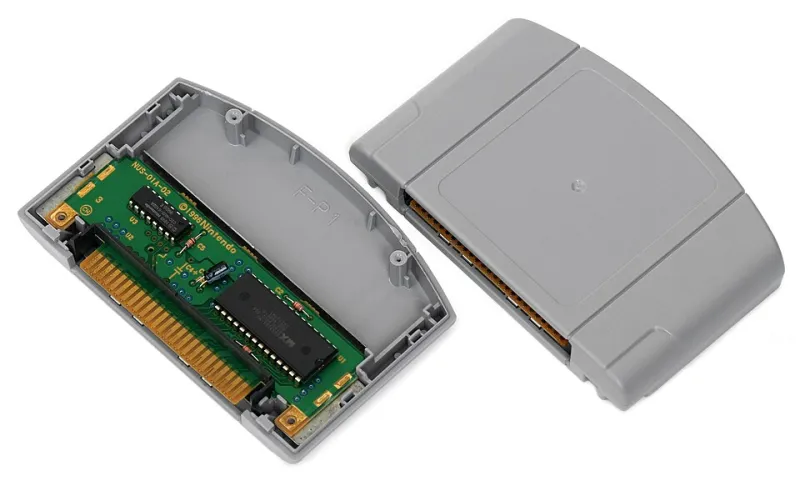
Photo: Evan-Amos, Public domain, via Wikimedia Commons
There's a version of the N64 era that most people remember — the one with the big releases, the iconic soundtracks, the controller that somehow had too many buttons and not enough at the same time. But there's another version running underneath all of that. A version made of hex strings, unused texture files, and developer initials hidden in places that required tools that didn't exist yet to find. That version is still being decoded.
And the deeper you go, the stranger it gets.
The First Layer Wasn't Even the Beginning
When people talk about N64 Easter eggs, they usually start with the obvious stuff. The face textures in Super Mario 64. The developer photos embedded in GoldenEye 007. The hidden message in The Legend of Zelda: Ocarina of Time's beta builds. These are the greatest hits — the ones that got written up in Nintendo Power, the ones your older cousin swore he found before you.
But those were the surface layer. The stuff the developers wanted someone to eventually find. The breadcrumb trail laid out for the curious but not necessarily the obsessive.
What dataminers started uncovering in the early 2010s — and are still uncovering now — is that several N64 studios were operating with a completely different philosophy running in parallel. The discoverable Easter egg was almost like a decoy. A reward for the casually curious that drew attention away from the stuff buried so deep it required genuine technical excavation.
Think of it like a puzzle box with a false bottom. You open it, you find something cool, you feel satisfied. But the developers knew the box had another compartment. They just didn't tell anyone.
Signatures in the Static
One of the most consistent patterns dataminers have found across N64-era ROMs is the developer signature — initials, handles, or short strings of text embedded in areas of the ROM that the game engine never actually reads during normal play. These aren't glitches or leftover compile data. In several documented cases, they're deliberately formatted, placed in consistent locations across multiple games from the same studio, and occasionally accompanied by dates or internal project codenames.
The implication is significant: these weren't accidents. Developers were using the dead space in their own cartridges as a kind of private ledger. A record that they were there, that they shipped this thing, that their name was inside it even if it would never appear on a title screen.
For a generation of developers working in an era where credits were routinely stripped by publishers — Nintendo itself had a famously complicated relationship with crediting its own staff — the ROM signature was a form of authorship that couldn't be edited out by anyone who didn't know to look for it.
Some of those signatures have been matched to known developers through cross-referencing with other projects. Others remain unidentified. A few appear to reference internal nicknames or handles that predate the public internet, making them essentially untraceable without someone from the original team coming forward.
The Puzzle Within the Puzzle
Here's where the design philosophy gets genuinely weird, and genuinely compelling.
Several researchers working in the N64 datamining community have documented what they describe as intentional obfuscation chains — sequences where one hidden element, once decoded, points toward another hidden element that requires a completely different method to access. Not a hint system. Not a developer being cute. A deliberate, multi-step trail that only makes sense if you assume the developer expected someone to eventually follow it.
The most cited example involves a specific title — details are still contested enough in the community that attributing it definitively would be irresponsible here — where a string of seemingly random characters in an unused audio file turned out to be a rotated cipher. Decoding it produced coordinates. Those coordinates, mapped onto the game's own internal geometry data, pointed to a texture that had been loaded into memory but never rendered. That texture contained an image. The image was a photograph of a whiteboard with a single line of text written on it in what appears to be Japanese.
The text, roughly translated, reads: If you found this, you found all of it.
That's not a bug. That's a message. And it was placed there by someone who designed the entire chain knowing that it would take hardware and software that didn't exist at the time of shipping to follow it to completion.
Why Bury Something You Want Found?
This is the question that makes the whole thing philosophically interesting, not just technically impressive.
The easy answer is ego — developers leaving their mark in a medium that was actively trying to erase them. That's real, and it's part of it. But the more you sit with the complexity of some of these hidden structures, the less satisfying that explanation becomes. You don't build a four-layer cipher just to sign your name. That's not a signature. That's a test.
Some researchers have floated the idea that certain N64-era developers were genuinely interested in the long game. Not in the sense of planning for dataminers specifically — the tools and communities didn't exist yet — but in the sense of encoding something for whoever eventually had the capability to find it. A time-locked message. A reward for technological progress.
There's something almost archaeological about the way modern dataminers describe the experience of finding these things. You're not just playing a game. You're excavating an artifact left by people who knew, on some level, that the artifact would outlast them.
What's Still Out There
The honest answer is: nobody knows. That's the part that keeps the community active.
Estimates vary, but several prominent N64 ROM researchers have suggested that a meaningful percentage of major N64 titles haven't been fully analyzed at the data level. Not because the tools aren't there — they are — but because the sheer volume of material, combined with the fact that many of the most interesting findings require domain knowledge about specific development studios' internal practices, means that the work is slow and requires collaboration across disciplines.
New finds still surface regularly. A developer message confirmed last year in a game that had been considered fully documented for over a decade. A texture atlas in a sports title that contains what appears to be a hand-drawn map of something that doesn't match any in-game location. An audio file in a racing game that, when pitch-shifted and reversed, plays back a melody that matches no known licensed track and hasn't been identified.
The cartridge was always the text. The developers just wrote in a language that took thirty years to start learning.
And if the philosophy holds — if the puzzle-within-the-puzzle design was as intentional as the evidence suggests — then some of what's still buried was placed there specifically because it would take this long to find.
Which means someone, back in 1997, was writing to us.
We're just finally starting to write back.