Why Online Subcultures Speak in Numbers — And What Happens When You Learn the Language
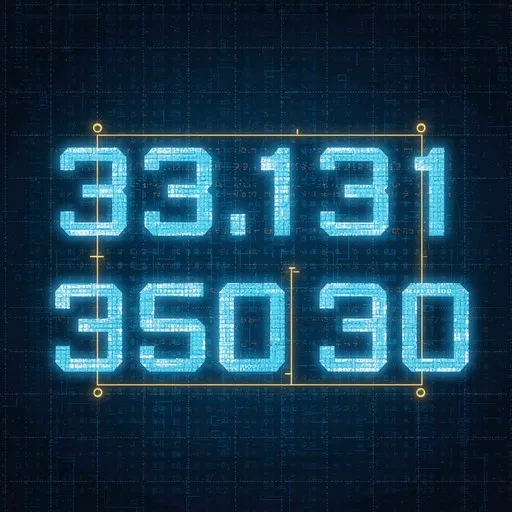
Photo: glowing numbers symbols screen digital code internet community neon, via images.stockcake.com
At some point, you've probably seen a string of numbers in a comment section or a Discord server and felt that specific flavor of exclusion — the kind where you know something is being communicated, you just don't have the key. That feeling is not accidental. It's the whole point.
Online subcultures have always had a complicated relationship with language. The more niche the community, the more it tends to develop its own vocabulary — and numbers, symbols, and codes are the most efficient version of that vocabulary. They're fast, they're deniable, and they do a very specific job: they tell you who's in and who's still reading the glossary.
This is a breakdown of how that works, why it persists, and what it actually means about who we are when we're online.
The Original Encoded Spaces
To understand why internet subcultures love numeric codes, you have to go back to the infrastructure that shaped early online culture.
Imageboard communities — 4chan being the most culturally significant in the US context — were organized by numbered and lettered boards from the start. /b/, /v/, /g/ — each designation became its own cultural territory with its own norms, in-jokes, and hierarchies. The board number or letter wasn't just an address. It became a badge of identity. Saying "I'm from /v/" communicated an entire set of assumptions about what you cared about, how you communicated, and what you found funny. The designation was the identity.
This structure normalized something important: the idea that a number or symbol could carry dense cultural meaning that only made sense in context. That's the seed of everything that followed.
Get numbers — the practice of quoting post numbers and treating certain repeating or sequential digits as meaningful — turned the mechanical act of posting into a game with social stakes. "Dubs" (repeating digits), "trips" (three in a row), and "quads" carried weight in those spaces not because anyone decided they should, but because the community collectively agreed they did. That's how all codes work, but seeing it happen in real time with something as arbitrary as post numbers made the mechanism unusually visible.
Speedrunning and the Notation That Built a Meritocracy
Shift to gaming communities and the relationship between numbers and identity gets even more interesting.
Speedrunning has developed one of the most elaborate numeric languages in any hobby community. Times are expressed down to fractions of seconds, and the difference between a "sub-20" and a "19:58" is the difference between respected and legendary. These aren't just measurements — they're status markers. The community has collectively decided which thresholds matter, and crossing them signals membership in an increasingly small group.
Beyond times, speedrunning has its own symbolic shorthand: "PB" (personal best), "WR" (world record), "RNG" (random number generator — meaning the unpredictable elements of a run), and increasingly specific terms like "wrong warp" or "ACE" (arbitrary code execution) that describe glitches in technical language precise enough to communicate to other runners and opaque enough to confuse everyone else.
ACE is worth dwelling on. Arbitrary code execution — the process of manipulating a game's memory through in-game inputs to run unintended code — is one of the most technically complex things happening in any gaming subculture right now. The community developed a notation system for documenting these exploits that looks closer to assembly language than to game discussion. It's a language built out of necessity, but it also functions as a wall. You have to care enough to learn it. That barrier is a feature.
TikTok's Numeric Vernacular and the Speed of Code Evolution
The newest iteration of this phenomenon is happening on TikTok, where numeric codes evolve and decay at a pace that makes older internet cultures look slow.
"1437" (I love you forever — counting the letters), "1234" as a reference to a specific viral audio, "555" borrowed from Thai internet culture where it means "hahaha" (5 in Thai is "ha") — these codes travel across communities and platforms so fast that by the time a mainstream outlet publishes an explainer, the code has already mutated into something else. That velocity is intentional. The faster a code evolves, the harder it is for outsiders to keep up.
What's distinct about TikTok's relationship with numeric codes is how deliberately they're used to evade content moderation. Communities discussing sensitive topics — mental health, substance use, politics — have developed numeric and symbolic substitutions specifically because algorithms flag words but struggle with context-dependent numbers. "Unalive" as a replacement for a word TikTok's moderation system flags is the text version of this, but numeric codes operate the same way. It's encryption built not for secrecy from other users, but for invisibility from automated systems.
That's a meaningful evolution. Early internet codes were about community identity. Current platform codes are increasingly about survival.
What the Code Reveals About the Community
Here's the pattern that runs through all of this: encoded communication isn't just about exclusivity. It's about trust architecture.
When a community builds its own language, it creates a system where fluency is earned rather than assumed. You can't fake knowing speedrun notation if you haven't watched enough runs to understand what the numbers mean. You can't drop the right chan board reference without having spent time in those spaces. The code is a proof-of-work system for cultural membership.
This matters more in online spaces than offline ones because online, identity is so easy to fake. Anyone can claim to be a fan of anything. Codes are the mechanism by which communities verify the claim. They're not gatekeeping for its own sake — they're a response to environments where gatekeeping is the only way to maintain a shared context.
The communities that rely most heavily on encoded communication tend to be the ones that have experienced the most disruption from outside attention. When a subculture goes mainstream, its codes either get abandoned (because the wall has been breached) or accelerate in complexity (to rebuild the wall faster). You can track the health and insularity of an online community by watching what happens to its vocabulary when it hits a broader audience.
The 64 In the Room
This site is called 64ForSuu. If you've been here long enough, you've probably wondered what that means — or maybe you already know. Either way, you get it: the name is the point. It's an invitation and a filter at the same time. The people who decode it feel something. The people who don't move on.
That's the whole mechanism, right there. A number, a name, a symbol — and suddenly you know exactly who you're talking to.
The internet didn't invent coded language. Marginalized communities, subcultures, and in-groups have always developed private vocabularies. What the internet did was accelerate the process, scale it globally, and make the codes visible enough to study in real time.
Learn the language. Or don't. But knowing it exists — and knowing why — changes how you read everything.